Dashboards for decision culture.
Librinth Tell runs practice scenarios that record what professionals prioritize in decisions under pressure, and then shows each of them the record.
Current scenario library: retail. Additional sectors in development.
Consider the evidence your organization actually holds about how people decide when it matters.
• What they say (values described in interviews, briefings and reviews).
• How they perform when observed (assessments, workshops and structured settings where everyone knows what is being watched).
• The results (outcomes that arrive after the fact, carrying consequences but rarely explanations).All three are real evidence, but each reflects either what people claim or how they behave when behaving is the point.A fourth kind of document would look different. It would record what a person actually chose, under genuine pressure, when every option was defensible, nothing signalled the right answer and they could not see what was being measured.In most organizations nothing produces that document.Leaders tend to go looking for it after a decision that:1. was made by someone they trusted, in a room they were no longer in,
2. broke no procedure and was locally defensible, and
3. that they still cannot fully explain.If no such moment comes to mind, and the three kinds of evidence you hold feel sufficient, this page will read as someone else's mail, and that is a fine outcome. If one does come to mind, what follows is a description of the missing document and the method that produces it.
What the record looks like
Librinth Tell delivers a diagnostic debrief to the individual professional at the end of each scenario run. It opens like this.
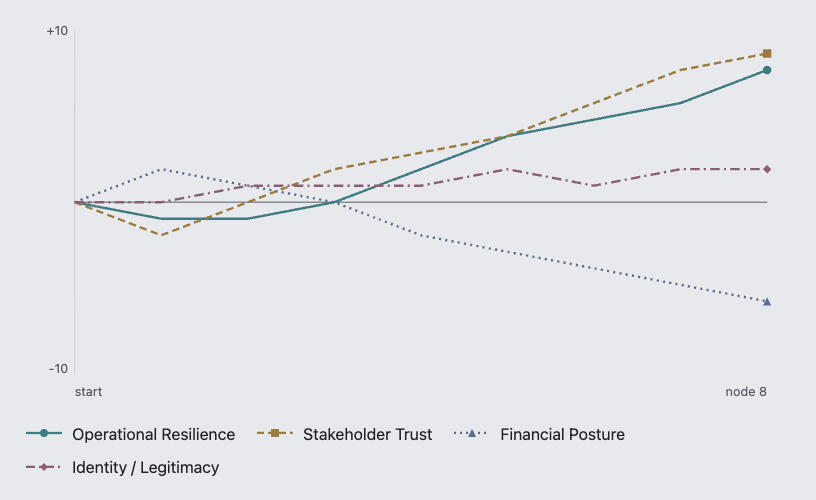
[A drift profile, the cumulative direction one run's decisions pulled across four dimensions. Synthetic specimen record, shown to demonstrate the format.]
Before seeing any output, the professional ranks the values they believe guided them. The debrief then presents the record:• A drift profile, the cumulative direction their decisions pulled across four dimensions of professional decision-making, covering operational continuity, the interests of the people affected, financial posture and fidelity to what the organisation claims to stand for.
• A decision audit, what each choice was actually weighing.
• A comparison between the values they ranked minutes earlier and the values their decisions revealed.
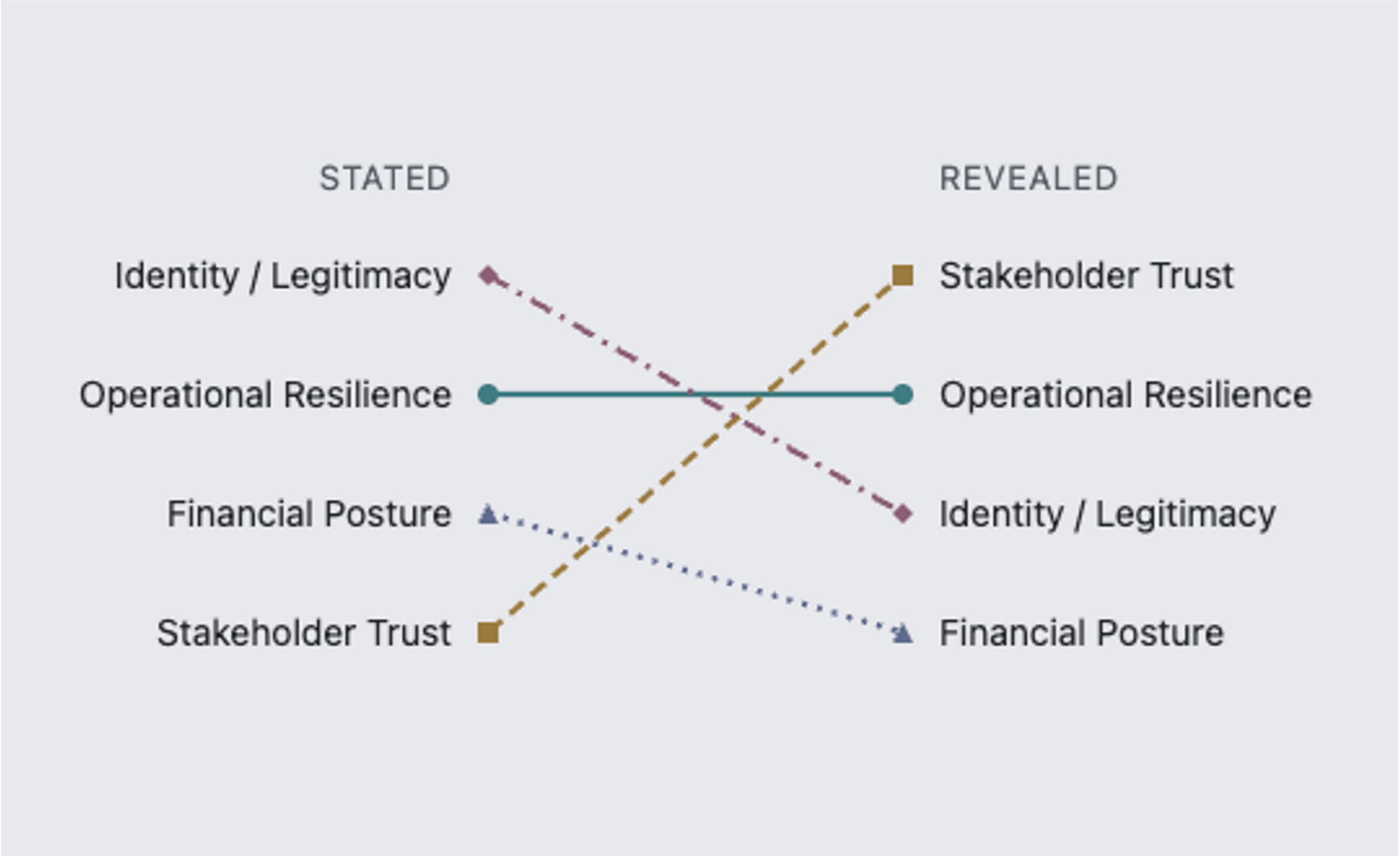
[The comparison at the centre of the debrief shows the gap between the values a practitioner ranked minutes earlier and the values their decisions revealed. Synthetic specimen record.]
The debrief does not grade, prescribe or tell the professional what the pattern means. It shows them something precise about how they decide, and leaves the interpretation with them.
How the record gets produced
Librinth Tell scenarios are constrained practice environments. A fictional company is built in full, with asymmetric information, competing demands and a clock. The professional inhabits a role inside it and moves through it.
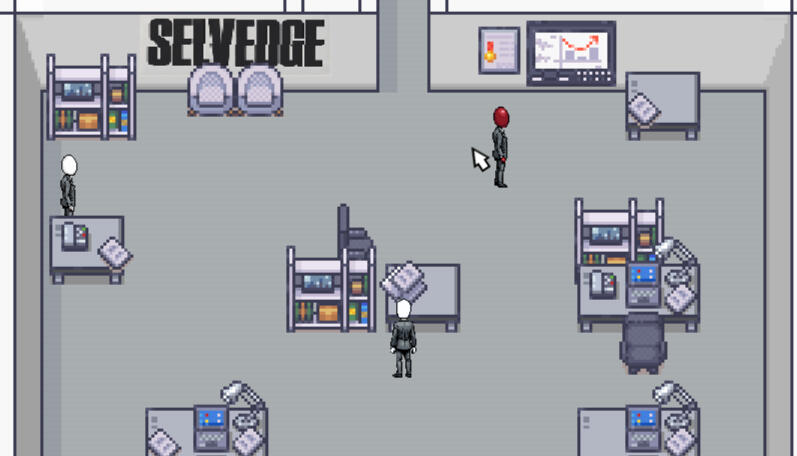
[This scenario is about a fictional mid-market retailer. The scenario world always reflects real pressures and details that belong to no one.]
At defined points the professional must commit. Every option is locally defensible and nothing signals which is correct. The choice is made, the door closes and the scenario continues. What any choice was measuring becomes visible only in the debrief.
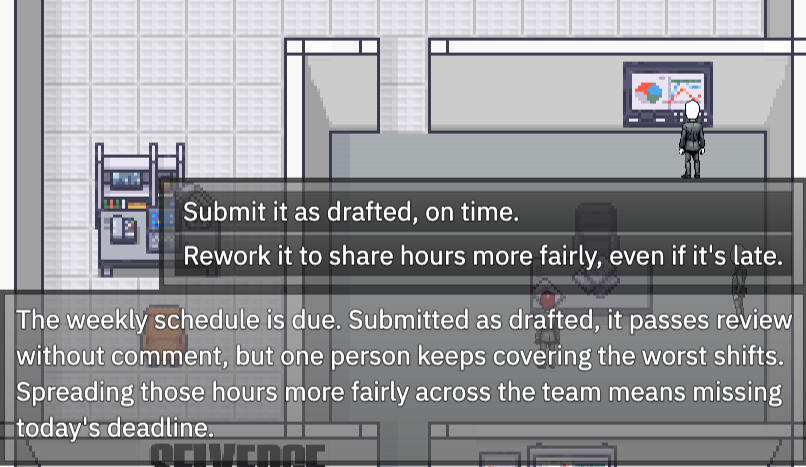
[A decision node. Every option is defensible, nothing signals the correct answer and the measurement is invisible until the debrief.]
The fiction is deliberate, and it is a measurement decision rather than a creative one. A professional who recognized their own employer in a Tell scenario would perform rather than decide. The scenario is built so its pressures are real while its details belong to no one, which is what lets decisions be genuine.A Tell scenario runs in a single sitting (under an hour), in a standard web browser, individually, at a time of the professional's choosing. There are no installations, facilitators or scheduled sessions.
Different questions with two formats
1. Hour of Impact rehearses acute crisis. It asks, 'How does a professional decide when everyone can see the moment is serious?'• One defining tension,
• Visible stakes,
• Every option costly, and
• No way back.2. Days of Impact rehearses ordinary operating conditions. It asks, 'Where do a professional's decisions drift when nothing feels important enough to watch?'• A sequence of individually unremarkable choices,
• None dramatic enough to trigger deliberate reflection, and
• The drift pattern is cumulative.Most organizations already know which gap concerns them. The visible-crisis question and the quiet-drift question are both Say–Do questions, but they are not the same question, and the format is chosen accordingly.Librinth Tell's published scenarios are built for retail. Scenarios are sector-specific, and additional sectors are in development. If your sector is not retail, we would still like to hear from you. What gets built next is informed by conversations.
If the question resonates
If the missing document this page describes is one your organization would want to hold, the next step is a short conversation about which of the two questions is yours, and where your sector sits against the current library of scenarios and the ones in development.
Librinth Tell is built by Librinth.